Practical options under pressure
Practise creating space, escaping grips, protecting balance and moving with purpose. Repetition helps make unfamiliar situations feel less overwhelming.

Confidence built through practice
Practical Japanese Ju-Jitsu for women who want useful skills, purposeful fitness and the confidence that comes from learning what their body can do.
More than a workout
Good self-defence training is not about expecting danger everywhere. It is about developing awareness, confident movement and practical options in a controlled environment.
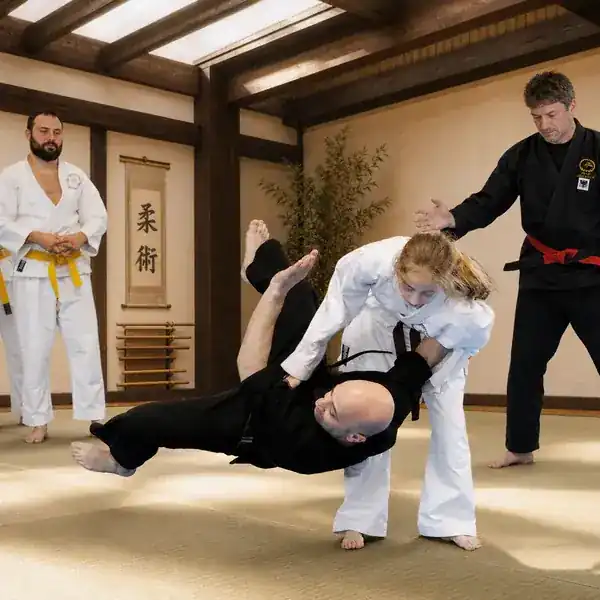
Japanese Ju-Jitsu combines strikes, escapes, throws, locks, balance and partner work. The variety keeps training interesting while helping beginners build a broad foundation rather than relying on one “magic” technique.
The responsibility for violence always belongs to the person who causes it. Training can offer useful choices and greater confidence, but no class can guarantee safety or make another person’s actions your responsibility.
Seven worthwhile reasons
The strongest benefits combine practical learning with the wider physical, psychological and social value of regular activity.
Practise creating space, escaping grips, protecting balance and moving with purpose. Repetition helps make unfamiliar situations feel less overwhelming.
Confidence becomes more useful when it grows from real practice. Research on women’s self-defence has reported improvements in self-efficacy and perceived physical competence.
Throwing, striking, controlled resistance and footwork challenge major muscle groups while developing balance, timing and whole-body coordination.
Instead of repeating exercises for their own sake, you move to solve a problem, learn a technique and support a partner. That sense of purpose can make activity more engaging.
Training asks you to concentrate on the present task. Regular physical activity also supports mental health and wellbeing according to UK public-health guidance.
Effective self-defence begins before physical contact: noticing changes, communicating clearly, setting boundaries and choosing when to leave are part of the wider skill set.
Partner practice creates shared progress. A welcoming club can offer routine, encouragement and social connection alongside the martial arts themselves.
What the evidence supports
Recent reviews of empowerment-based self-defence programmes report promising outcomes, including greater self-efficacy and fewer incidents of some forms of violence among participants. Researchers also stress that more work is needed to identify which course formats are most effective for different groups.
Separately, UK physical-activity guidance emphasises the value of regular movement, strength and balance for physical and mental health. Martial arts can contribute to that active lifestyle when training is appropriate to your ability.
A broad martial art
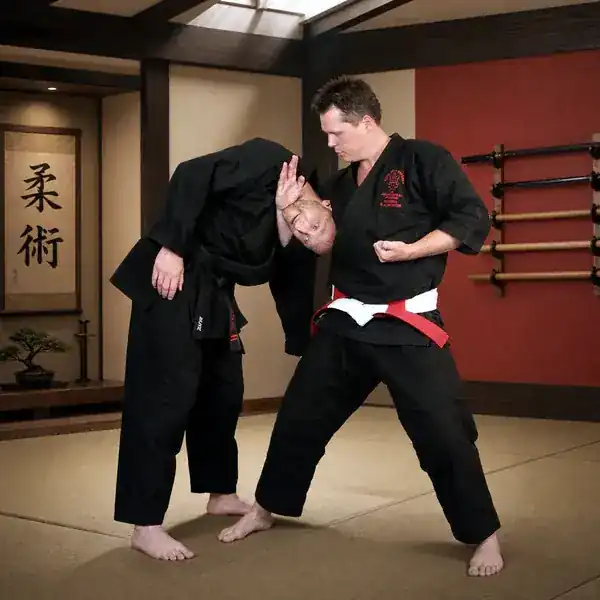
Japanese Ju-Jitsu brings several ranges of training together. Students can learn how posture, distance and timing connect to striking, escapes, throws, joint controls and groundwork.
Starting from zero is normal
You are not expected to arrive fit, flexible or already confident. Your first class is an introduction, not a test.
Explain that you are new and mention any injury or movement concern that may affect your training.
Begin with posture, movement and a small number of techniques explained step by step.
Work cooperatively with a partner rather than trying to “win” the exercise.
One session lets you judge the teaching, atmosphere and physical challenge for yourself.
Hayleigh Hume highlights Total Self Defence’s Ju-Jitsu experience and its training for both adults and children.
Questions before starting
No. Complete beginners can learn the foundations progressively through controlled practice.
No. Begin at a manageable pace and allow fitness, balance and coordination to develop through regular training.
No. The regular Muswell Hill sessions are mixed classes rather than women-only classes. Contact us if you would like to check whether the class setup feels right for you.
Comfortable sports clothing is suitable for a first class. Remove watches and jewellery before training.
No martial art can guarantee safety. Good training develops awareness, movement, confidence and practical options while recognising honest limits.
Research and guidance
The page uses cautious conclusions from public-health guidance and research. The class itself teaches Japanese Ju-Jitsu and is not presented as identical to the specialist empowerment programmes studied in every paper.
Start without pressure
Join a regular mixed class at The Birchwood Centre in Muswell Hill and decide whether the training suits you.